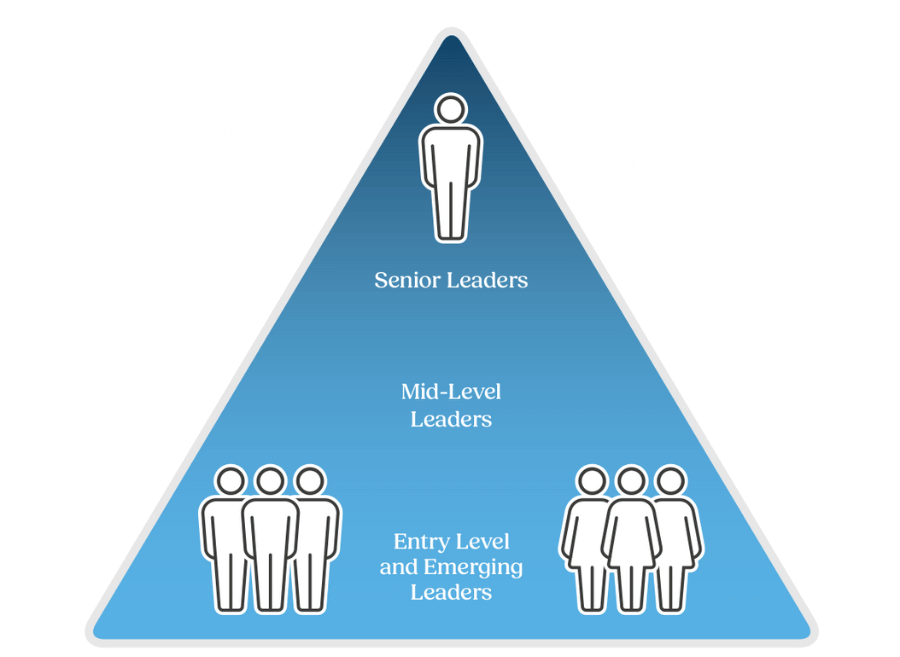
Leaders are made, not born.
The problem is that society doesn't make them anymore.
Once upon a time, we raised leaders. Children learned basic social and interactive people skills through organizations like Boy Scouts or Girl Scouts. Sports were largely recreational for a longer period of time, so many children played on teams deep into their formative years; it’s where many first learned what it meant to be part of a team and received their first taste of leadership. This has changed, and corporate America is feeling the brunt!
LEADERS OF SELF
"They're not ready."
Those new to the workforce are not equipped with the basic interpersonal and communication skills needed to navigate the modern workplace. In fact, a stunning 55% of hiring managers reported in an Intelligent.com survey that they were involved in firing a recent graduate in 2024. Their complaints were about fundamentals: initiative, accountability, response to feedback, teamwork, professionalism. Simply put, without basic people skills, they’re not ready.
LEADERS OF OTHERS
"They'll figure it out."
Newly promoted leaders may have proven that they know how to lead themselves, but they’re not being trained how to lead others, and promotion without training is painful for all. However, Gallup reports that companies fail to choose the right candidate 82% of the time, and more than half of those chosen never receive formal leadership training. The “figure it out” approach is a gamble that is dangerous and costly to all.
LEADERS OF LEADERS
"They're thoroughly adequate."
Rising leaders who never received any formal leadership training are now expected to develop other leaders. Gallup attributes roughly 70% of the variance in team engagement to the manager alone. Said differently, not only is your lowest-performing team being led by someone who was never trained, they are probably being developed by someone who was never trained either…and most employees equate their organization to their experience with their leader.
The danger with all of this is disengagement.
An engaged workforce is the one thing that every organization needs above all else. Without it, the mission of the organization is in jeopardy. And disengagement is the precursor to turnover and safety incidents.

The Data
Symptoms and Statistics Caused by Untrained Leaders
Employee Engagement isn’t a ‘soft’ metric; it is the leading indicator of your operational health, and it is the number one symptom of poor leadership. Employee Engagement is the precursor to all other people problems – especially safety and turnover. The data shows the impact of poor leadership.
7 in 10
Employees
Lack Engagement
Gallup
“Unengaged” means employees are psychologically unattached to their work. They are often waiting for a reason to leave. They do not exert discretionary effort, and without a strong leader to pull them back into the “Tribe,” they represent the single greatest drain on your company’s potential.
7 in 10
are primarily
Influenced by their Boss
Gallup
The direct boss is the architect of the employee experience, and 70% of the difference between your highest-performing teams and your lowest-performing teams has everything to do with the quality of the person leading them. If the leader disengages, the team is sure to follow.
3 in 10
Employees
Trust their Boss
DDI
Only 30% of employees strongly trust their boss. Leadership is built on a foundation of trust; without it, influence is impossible. When 70% of your people are skeptical of their leader’s competence or intent, communication breaks down, and the “Tribe” dissolves into a collection of individuals looking for the exit.

The Engagement Tax
The Engagement Tax refers to the hidden costs organizations incur due to employee disengagement and high turnover. When employees are not fully engaged, their productivity and commitment suffer, resulting in significant financial losses for the company. The delta between what you pay your employees and the productivity you receive is an Engagement Tax.
Key Points:
- High turnover rates are costly, with replacement costs ranging from 50% to 200% of an employee's salary.
- Only 30% of the U.S. workforce is considered engaged, according to multiple research sources.
- Investing in leadership development can significantly reduce these costs by increasing employee engagement and retention.
The Result
The Number 1 reason employees leave a company is due to a toxic culture.
Since managers account for 70% of the variance in engagement, their behavior is the culture .
Toxicity is the #1 predictor of attrition, outweighing even compensation by over 10 to 1.

What's the Solution?
The solution to the problem lies in a proven formula that is foreign to much of corporate America; the solution is a bottom-up, hands-on approach implemented by proven leaders who have lived and thrived by the very curriculum your leaders learn.
At Tribe&Trust, we focus on aligning frontline leaders with their company’s mission within the core values they’re responsible for maintaining – all essential for executing strategies and driving success. Our proven method ensures that leadership training is practical, actionable, and directly relevant to your organization’s needs.
Discover how we can transform your organization and build a strong foundation of effective leaders.